

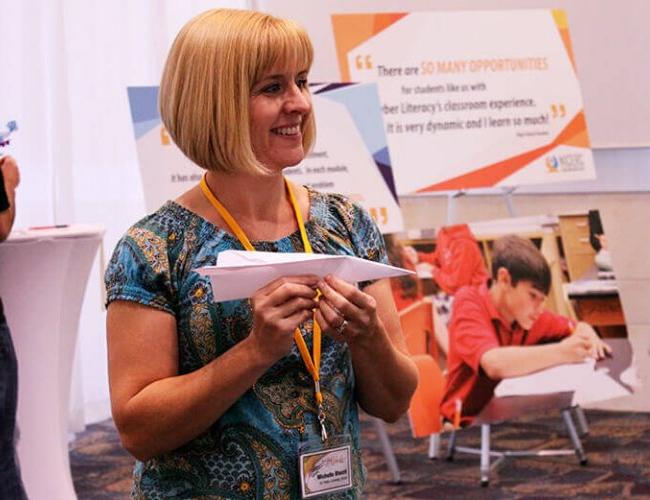
Imagine a classroom full of students who are on the edge of their seats, filled with enthusiasm and questions, and engaged in learning about how science, technology, engineering, math, and liberal arts all integrate together. It’s a unique learning environment that many teachers strive to create in their classroom but may not be able to due to a lack of resources, tools, and/or professional development training.
It’s this vision that attracted approximately one hundred fifty middle school and high school teachers from across the nation to participate in the 2014 Education Discovery Forum (EDF). Throughout the week, teachers received hands-on professional development training that will allow them to bring new projects, technology, and curricula into their classrooms. The EDF, which was held at the Shreveport Convention Center and hosted by Cyber Innovation Center’s National Integrated Cyber Education Research Center (NICERC), provided teachers with hands-on guidance and mentorship from subject matter experts from NICERC and Louisiana Tech University. The event was supported by a grant from the Department of Homeland Security.
During the EDF, middle school teachers built catapults, designed egg-drop vessels, and created flashlights while high school teachers launched rockets, tested circuits, and programmed robots. The projects showcased at the EDF are at the core of NICERC’s curricula and will help the participants better teach important STEM (science, technology, engineering, and math) fundamentals to students.
“The Education Discovery Forum is all about empowering teachers so that they can more effectively engage this new generation of students. By equipping teachers with resources and providing innovative curricula, teachers can create a highly interactive, project driven learning environment,” explained GB Cazes, Vice President of the Cyber Innovation Center.
NICERC’s unique curricular offerings included STEM: Explore, Discover, Apply; Cyber Literacy; Cyber Science; Physics; and Advanced Math for Engineering and Science. Collectively they make up a vertically integrated curriculum that offers students multiple opportunities to further gain an appreciation for STEM throughout their academic careers.
NICERC’s Deputy Director, Paul Spivey, added, “NICERC’s collection of curricula is designed to inspire more students to pursue degrees in STEM and as a result help to meet growing workforce demands across our state and nation. We are proud to